ALZ
Camera-free assistive care for dementia households
ALZ is an edge-first assistive care prototype for families caring for someone with Alzheimer's, Parkinson's or dementia. It senses presence, movement and routine with WiFi and radar instead of cameras, responds with calming prompts on the device, and alerts a caregiver only when it matters.
Overview
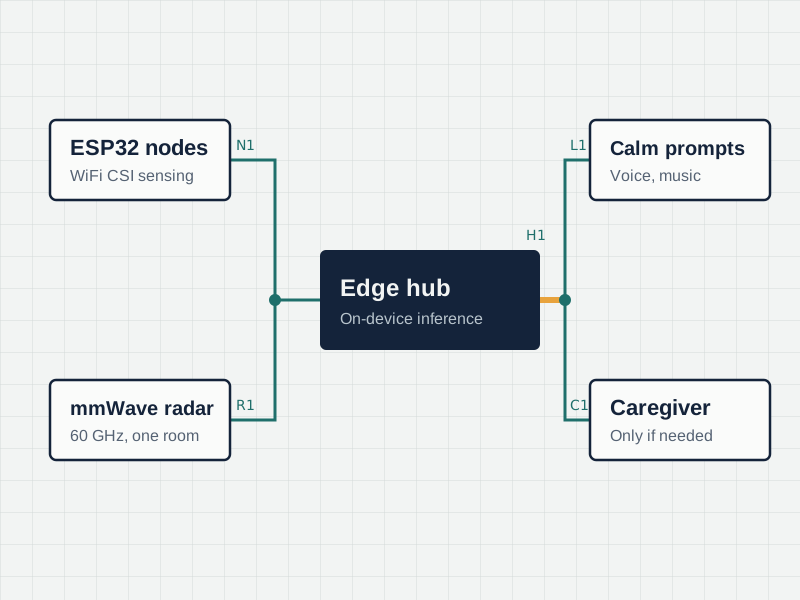
Neurodegenerative conditions have no definitive cure, and families carry a heavy supervision burden. Existing monitoring is often expensive, relies on continuous cameras and cloud video, or needs wearables that people with dementia take off. ALZ is built around cheap, easily available hardware and keeps processing on the device, so dignity and privacy are part of the design rather than an afterthought.
ALZ is an assistive wellness product, not a medical device. It does not diagnose or treat disease, it cannot detect every fall or emergency, and it is not a substitute for human care or medical supervision.
Key Capabilities
Camera-free sensing
ESP32 nodes read WiFi channel state information to detect presence, motion and routine. No cameras and no wearables to forget or remove.
Fall and breathing signals
A 60 GHz mmWave radar module adds best-effort fall events and breathing rate at rest, fused with WiFi activity patterns.
Personal baselines
The system learns each home's routine and flags pacing, agitation or unusual inactivity against that person's normal.
Local first response
Calming voice prompts, familiar music or TV play on the device before any human is notified.
Caregiver support
Probability-based alerts instead of constant notifications, with daily and weekly summaries to reduce burnout.
Privacy by design
No video, images or facial data are stored. Raw signals are discarded after feature extraction and only events leave the device.
Challenge and Approach
The Challenge
Caregivers face continuous supervision, late detection of falls and agitation, and few affordable, non-intrusive options. Clinical-sounding products and always-on cameras are a poor fit for a person's own home.
Our Approach
Two ESP32 nodes, one mmWave module and a phone or small computer as the edge hub. Decisions are probabilistic and fused across sensors rather than binary on one signal, with inactivity alerts as an independent safety net. The local response comes first, and humans are notified only when needed.
Where It Stands
ALZ is at prototype stage. The detection, intervention and caregiver-app logic runs end to end on simulated sensor data. Real-home validation is the next step, and we make no accuracy claims until that evidence exists.
Technology
How It Works
Sensors collect data locally and the hub extracts features on the device, discarding raw signals. A probability engine estimates fall, agitation and inactivity risk against the home's own baseline. The system responds first with calming prompts, and escalates to caregivers only for high-confidence events, keeping a human in control throughout.